
When you stick your foot down onto the accelerator, you expect a smooth and continuous application of power. Hitting the go pedal is fun, but reliable acceleration is also necessary for safety on the road. Defensive driving means anticipating and sometimes avoiding dangerous situations — something that is considerably more challenging to do when your car refuses to get up and go.
Loss of power is a frequent customer complaint across a range of models and makes. Although the symptom is common, the underlying causes can vary. If your car seems to be losing its grunt, then one of these three problems might be to blame.
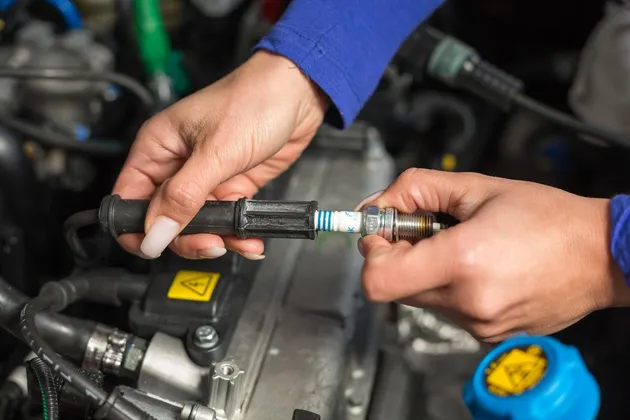
1. Old or Fouled Spark Plugs
What’s the most common cause of weak acceleration? Poor maintenance.
Your car’s engine relies on fuel/air combustion to generate motive power. For gasoline (as opposed to diesel) engines, a spark is required to ignite the compressed gases in each combustion chamber. Your spark plugs provide this jolt, but the electrodes foul and wear over time. Eventually, they lose their effectiveness and can no longer provide a reliable spark for combustion.
When your car’s spark plugs have passed their prime, you can expect a range of symptoms from poor idling to loss of acceleration to noticeable misfires. Spark plugs typically must be replaced every 60,000–100,000 miles, but other engine conditions may lead to premature fouling.
2. Lean Running Conditions
In addition to spark, your engine needs a proper mixture of fuel and oxygen. Deviating from this ratio results in a rich (too much fuel) or lean (too much air) condition. Both situations lead to reduced engine efficiency and potential damage, but a lean condition may also produce a noticeable lack of power.
Why is too much air a bad thing? An uneven fuel/air mixture produces incomplete, inefficient combustion. In this case, your engine doesn’t receive enough fuel for the amount of air in the combustion chamber. Not only does this hurt your fuel economy, but it can also create a noticeable loss of power and hesitation when accelerating from a stop.
Lean conditions can sometimes be challenging to track down since they have many potential causes. In many cases, they are the result of vacuum leaks or failing oxygen sensors. Sometimes a lean condition may be from insufficient fuel flow as a result of dirty injectors, a bad fuel pump, or a clogged fuel filter.
3. Transmission Problems
Your engine produces power, but that power must take several more steps before it reaches your wheels. For rear-wheel drive cars, your engine’s power is multiplied by the transmission before transmitting to the differential via the driveshaft. For front-wheel drive vehicles, the transmission and differential are typically combined into a single unit known as a transaxle.
Since your transmission is responsible for transmitting power, internal transmission issues can lead to acceleration problems. Your engine still produces at full output, but your transmission doesn’t get that power to the wheels. Without this crucial step, your car may feel sluggish, hesitate before shifting, or not want to move at all.
Unfortunately, transmission problems are often not cheap to address. Issues with shifting sometimes result from a fluid leak or failed solenoid, but severe problems may point to internal transmission issues. Since damage can occur quickly in transmissions that are overheating or low on fluid, avoid driving a car exhibiting any problems with shifting.
Don’t waste time living with a car that’s clearly down on power. Powers Transmission can help you to diagnose the issue and fix it without blindly throwing parts at the problem. Get in touch with us online to set up an appointment today!